As an Amazon Associate, we earn from qualifying purchases. Some links on this site are affiliate links at no extra cost to you. Our recommendations are based on thorough research and editorial judgment.


How Does The Read-Option Play Work In Football?

The read-option play in football is a strategic offensive maneuver that allows the quarterback to assess defensive formations immediately after the snap. By focusing on a designated defender, usually the defensive end, the quarterback decides to either hand off to the running back or keep the ball himself. This decision hinges on the defender’s actions, creating opportunities for both the quarterback and running back. Key drills and film study enhance its execution, revealing further insights into its development and impact on modern football.
Key Takeaways
- The read-option strategy allows the quarterback to decide between handing off the ball or keeping it based on a defender’s movements post-snap.
- Offensive linemen create favorable blocking conditions through schemes like man-blocking and zone blocking, ensuring a successful play execution.
- The quarterback evaluates the read defender’s actions at the mesh point, with quick decisions crucial for play effectiveness.
- Defensive strategies, such as gap control and blitzing, are implemented to counteract the read-option and disrupt the quarterback’s decision-making process.
- Practicing the read-option involves drills focusing on the mesh exchange, decision-making under pressure, and blocking responsibilities between quarterbacks and running backs.
Understanding the Read-Option Concept
Understanding the read-option concept is essential, as it represents a pivotal strategy in modern football that merges decision-making dynamics with offensive execution. Developed through its historical evolution, the read option allows a quarterback to analyze defensive adjustments post-snap, primarily targeting a specific defender, often the end man on the line of scrimmage. This strategy exploits the defender’s reaction at the mesh point, creating the potential for the quarterback to either hand off the ball, keep it, or occasionally make a pass. By complicating defensive assignments, the read option forces defenses to make quick decisions, ultimately disrupting their gap integrity and assignment soundness. This creates opportunities and highlights the significance of quarterback mobility in today’s fast-paced football landscape. Additionally, proper training with tackling dummies can significantly improve a quarterback’s ability to execute the read-option effectively.
The Anatomy of a Read-Option Play
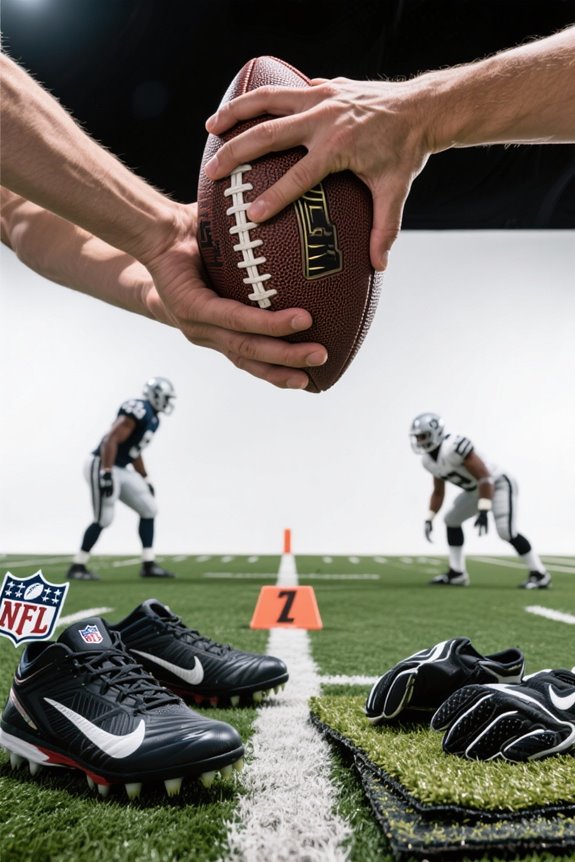
The read-option play exemplifies a strategic offensive maneuver in football, intricately designed to create confusion and exploit defensive weaknesses. The offensive line typically adopts a zone blocking scheme, while the quarterback aligns in a shotgun or pistol formation, often with a running back beside him. Pre-snap motion, such as jet motion, influences defensive adjustments and opens running lanes. Critical to the play is the “read” defender, whose initial movement dictates the quarterback’s decision. At the mesh point, the timing between the quarterback and running back is essential for executing either a handoff or a keeper. Additionally, variations like counter actions and passing options help further challenge defensive schemes, maintaining unpredictability and enhancing offensive effectiveness. Proper helmet safety is crucial as 70% of injuries can be mitigated with a well-maintained helmet.
Key Players Involved in the Read-Option
In the execution of a read-option play, several key players interact to create an effective offensive strategy. The running back’s responsibilities include reading the defensive end’s tactics at the mesh point, determining the ideal run path. Offensive line techniques involve executing zone or power schemes, shaping defenders’ reactions and sealing running lanes. The defensive end plays a vital role, requiring discipline to influence quarterback decisions by either crashing inside or containing outside. Moreover, tight end contributions and fullback functions are essential for second-level blocking, ensuring defensive engagement is neutralized. Timing importance in these interactions maximizes running efficiency and open field opportunities, while angle adjustments by offensive players enhance the effectiveness of the read-option play. Additionally, implementing proper weight distribution techniques within lineman training equipment can significantly improve blocking effectiveness during such plays.
The Role of the Quarterback
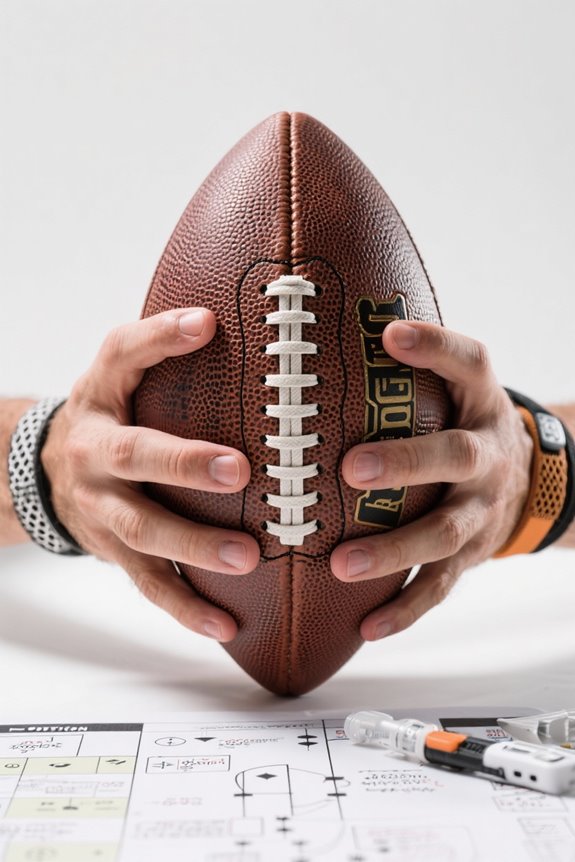
A quarterback’s role in the read-option play is pivotal, requiring a blend of physical toughness and mental acuity to navigate split-second decisions. The quarterback is tasked with multiple responsibilities, including diagnosing defensive alignments and executing effective play execution. Physical skills are essential, enabling the quarterback to evade tackles and absorb hits while maintaining ball security. Their mental acuity aids in the decision-making process, facilitating quick assessments of whether to hand off, keep, or pitch the ball based on defender movements. Offensive coordination demands the quarterback adapt to various schemes and formations, ensuring ideal reads and flow. Ultimately, the quarterback’s role balances risk and reward, as they become both a primary ball carrier and a strategic decision-maker on each play. Their understanding of brand reputation and quality in helmet construction also plays a role in protecting them on the field.
Reading the Defense: The Decision-Making Process
Reading the defense correctly is an essential aspect of executing the read-option play successfully. The key defender roles, primarily the unblocked backside defensive end, dictate the quarterback’s decision to hand off or keep the ball. Immediately following the snap, the quarterback begins evaluating the defender’s reaction, critical for real-time decision-making. If the defender crashes, the quarterback typically retains possession; if the defender remains wide, the handoff follows. Teams may employ defensive adjustments, such as gap exchanges or blitzes, to challenge the quarterback’s read and disrupt timing. This dynamic process underscores the significance of recognizing defensive formations and maintaining disciplined recognition throughout the play, ensuring effective offensive execution. The read-option effectively alters defensive strategies, creating a continuous offensive and defensive chess match. Furthermore, successful execution of the read-option often relies on targeted training to enhance a quarterback’s decision-making skills and accuracy.
Handing Off vs. Keeping the Ball
Executing a successful read-option play hinges on the quarterback’s decision to either hand off the ball or keep it, with critical implications for the offense. The decision relies on handoff mechanics, where the quarterback must recognize the edge defender’s movements at the mesh point. If the defender crashes inward, the quarterback may opt to keep the ball, capitalizing on open space outside. Conversely, if the defender maintains outside containment, the quarterback executes the handoff to the running back, optimizing interior running lanes. Effective keeping strategies exploit the defense’s commitment to the running back and create numerical advantages in open field scenarios. Alternating between these two options maintains unpredictability, disrupting defensive discipline and maximizing offensive efficiency. Additionally, high-quality materials have been shown to contribute to an athlete’s overall performance during such critical plays.
Variations of the Read-Option
While many may view the read-option play as a singular offensive strategy, it encompasses various adaptations that enhance its effectiveness against different defensive schemes. For instance, the jet sweep fundamentals involve a wide receiver’s motion, creating misdirection and aiding outside runs. Additionally, triple option strategies introduce a third decision layer, compelling the quarterback to determine whether to keep or pitch the ball. Zone read applications utilize offensive line roles to execute zone blocking, simplifying the quarterback’s reads. Moreover, read-pass mechanics allow a swift shift to passing based on defensive reactions, while power read techniques challenge defenses with more physical rushing approaches. These variations collectively maximize the read-option play’s potential to exploit defensive vulnerabilities, shining a light on the importance of fit when selecting protective gear like rib protectors in football.
Recommended Products

TOP-TIER PROTECTION: All Schutt F7 AiR models earned the highest rating from the independent Virginia Tech Helmet Lab

TOP-TIER PROTECTION: All Schutt F7 AiR models earned the highest rating from the independent Virginia Tech Helmet Lab
50 Scrimmage vests - numbered 1-50
The Power Read Option Explained
The power read option represents a sophisticated variation of the read-option play, strategically designed to manipulate defensive schemes and optimize offensive performance. This tactic employs a man-blocking scheme featuring down blocks and a pulling guard, targeting key defensive alignments. The quarterback must demonstrate acute situational awareness, reading specific defenders to decide whether to hand off the ball or maintain possession. Effective execution hinges on strong blocking schemes, ensuring a favorable hat-on-hat situation. Additionally, the power read may incorporate offensive adjustments based on the defense’s configuration. The speed and agility of both the quarterback and running back are essential in achieving effective run fits, enhancing the overall game strategy and maximizing yardage gained in critical game scenarios. Incorporating football workout programs can greatly enhance the skill set of players involved in executing this complex strategy.
Defenders’ Responsibilities in the Read-Option
Defenders in football must adhere to specific responsibilities when facing a read-option play, as their roles are essential in neutralizing the offensive threats it presents. Defensive ends focus on quarterback containment, ensuring the QB remains inside their designated area. Their disciplined aggression allows them to serve as the key read for the offense. Linebackers must emphasize gap integrity and demonstrate linebacker tracking to limit the running back’s options while making swift decisions to avoid being misled by fake handoffs. Additionally, defensive backs must effectively execute safety adjustments and engage in coverage communication to adapt post-snap to any changes. By maintaining assignment discipline, defenders can counter the dynamic threats inherent in the read-option strategy, minimizing the potential for significant offensive gains. The importance of proper fit based on arm circumference in the context of defensive players wearing protective gear can also help maintain performance and safety during intense plays.
Common Defensive Strategies Against the Read-Option
Common defensive strategies against the read-option play involve a multifaceted approach that aims to disrupt the offense while maintaining gap integrity and assignment discipline. Defensively, schemes utilize specific alignments, such as the 3-3-5 formation, enhancing gap control and read responsibility distribution. Shifting defensive fronts create misread triggers, thereby complicating quarterback decisions. Coverage adjustments, like deploying a single high safety in press man coverage, effectively limit quick passing options. Employing blitz strategies from unexpected angles forces quarterback hesitation, while coordinated communication between linebackers and defensive ends guarantees proper option responsibilities are upheld. Additionally, real-time responses to offensive shifts enhance situational adaptability, allowing defenses to maintain control over running lanes and guarantee effective tackling against dynamic read-option plays. A robust training regimen utilizing tackling dummies can further reinforce proper technique development in practice scenarios.
The Importance of Timing and Execution
Timing and execution stand as pivotal components of the read-option play, directly influencing its effectiveness on the field. The quarterback’s ability to quickly assess the unblocked edge defender after the snap is determined by timing precision, impacting the decision to hand off or keep the ball. Early recognition of defender movement is essential; hesitation can lead to lost opportunities as defenders recover. Additionally, execution consistency at the mesh point between the quarterback and running back is critical, requiring precise coordination to avoid fumbles. Offensive linemen’s blocking must synchronize with the quarterback’s decision-making, ensuring all components operate flawlessly. Collectively, these elements create an advantage over defenses, emphasizing how timing and execution shape the read-option play’s success.
Practicing the Read-Option Effectively
Practicing the read-option effectively requires a structured approach that emphasizes the precise coordination between quarterbacks and running backs. Repeated drills focusing on the mesh exchange are essential for developing a natural feel for whether to give or keep the ball, particularly based on the defensive end’s action. Coaches often simulate defenders, allowing quarterbacks to hone their sight reads and make rapid decisions. Incorporating decision drills, quarterbacks learn to react appropriately when defenders crash or hold their position. Additionally, using hand shields for blocking techniques helps backs understand their responsibilities in the option scheme. Continuous practice with these drills fosters timing, awareness, and overall execution, ensuring players develop instinctual responses vital for success in actual game scenarios.
Recommended Products

Complete Set for Peak Performance: Unlock your athletic potential with the Grestar Agility Training Equipment! This football training equipment features a versatile 20ft agility ladder with 4 metal stakes, 12 durable football cones with a cone holder, a running parachute for speed training, a jump rope, and 5 resistance bands – everything you need for comprehensive speed and agility training equipment in one set

【Football Training Equipment Set】 Includes 1 yellow speed training ladder with 4 steel spikes (20 feet long, 12 rungs), 12 football cones, 1 running resistance umbrella, 1 jump rope, 1 carry bag. It can meet your training requirements and make your life healthier

🔥【Speed Agility Training Set】: Our football training equipment,Designed with high-quality materials, this speed agility training set is built to get you through rigorous workouts and enhance your athleticism. Achieve new levels of agility and speed with fast footwork circuits and plyometric movements. Set up challenging training configurations with 10 adjustable ABS plastic hurdles and 12 lightweight, flexible training cones that will help with any number of drills and activities.
Film Study and Preparation Techniques
Film study and preparation are critical components in the successful implementation of the read-option play in football, providing players with valuable insights that enhance their performance on game day. Effective film analysis begins with a mastery of football terminology and formations, enabling players to identify opponent tendencies, such as defensive alignments and blitz packages. Additionally, analyzing the execution of the read-option within their own team helps players scrutinize the quarterback’s footwork and decision-making. Recognizing defensive movements, particularly of the end and linebackers, allows teams to anticipate key reactions. Coaches often utilize technology tools to organize footage, enabling detailed examination of defensive strategies and player habits, which can greatly inform game plans for peak execution of the read-option play.
Exploiting Defensive Weaknesses With the Read-Option
Understanding and exploiting defensive weaknesses with the read-option play requires a well-coordinated offensive strategy, effective communication among players, and a thorough analysis of opposing defenses. The defensive alignment dictates the responsibilities of defensive ends, who must balance defending the dive and containing the quarterback. When defensive ends overcommit or fail to maintain gap discipline, they create vulnerabilities that offenses can exploit through offensive deception. Linebackers and safeties must remain disciplined, preventing lanes from opening, but if they overcommit, it can lead to significant quarterback gains. Such defensive misalignments can be capitalized upon, forcing teams to reconsider their defensive approach. Ultimately, success with the read-option hinges on recognizing and targeting these specific defensive weaknesses.
Recommended Products

SIMULATE CONTACT: Contact simulation enables realistic practice while reducing the risk of injury THICK PADDING: 4” thick foam padding delivers optimal protection during...
The Evolution of the Read-Option in Modern Football
As the landscape of modern football continues to evolve, the read-option play has undergone significant transformations that reflect changes in offensive philosophies and player capabilities. This evolution, rooted in its historical significance, has seen early developments in college football, particularly under coaches like Rich Rodriguez and Urban Meyer, who popularized its strategic adaptations. By the mid-2000s, innovations such as the Inverted Veer emerged, increasing the tactical complexity of the play. The NFL initially hesitated to embrace the read-option, prioritizing quarterback safety, but eventually adapted to incorporate dual-threat quarterbacks and modified offensive strategies. The subsequent emergence of the Run-Pass Option (RPO) further expanded the read-option’s effectiveness, allowing quarterbacks to exploit defensive alignments with greater flexibility and precision.
Frequently Asked Questions
How Did the Read-Option Play Originate in Football?
The read-option play originated as a revolutionary tactical choice in college football, evolving from the triple option concept. It drew inspiration from earlier formations, allowing quarterbacks to exploit defensive tendencies effectively, transforming offensive strategies remarkably.
What Teams Have Perfected the Use of the Read-Option Strategy?
The Ravens offense, 49ers strategy, Seahawks execution, and Titans adaptation exemplify the read-option’s effectiveness, each team showcasing unique approaches that enhance their offensive capabilities and challenge opposing defenses through innovative play execution and strategic flexibility.
Are There Specific Formations That Work Better for the Read-Option?
Like a painter choosing the perfect canvas, specific formation types for the read-option, such as shotgun and spread, create offensive advantages by aligning players strategically, enhancing spacing and blocking efficiency to exploit defensive weaknesses effectively.
How Has the Read-Option Changed Over Recent Seasons?
The read-option has evolved through strategic adaptations as teams integrate more complex elements, employing formations and play actions that challenge defenses. This evolution enhances unpredictability, making it a pivotal component in modern offensive schemes.
What Are the Risks of Using the Read-Option Play Frequently?
Like a delicate dance, the frequent read-option exposes quarterbacks to injury risk and vulnerability against aggressive defenses. Predictability in offensive strategy often leads to successful defensive adjustments, ultimately compromising the effectiveness and safety of the play.


