As an Amazon Associate, we earn from qualifying purchases. Some links on this site are affiliate links at no extra cost to you. Our recommendations are based on thorough research and editorial judgment.


How Do Safeties Read Plays In Football?

Safeties read plays in football through a combination of pre-snap analysis and player identification techniques. They assess offensive formations, recognize personnel packages, and analyze quarterback behavior to anticipate plays. Key observations include running back positioning and tight end alignment. Eye discipline allows safeties to adjust focus based on coverage type and react effectively. Communication with teammates further enhances their response strategies. Understanding these fundamentals aids safeties in executing their responsibilities on the field, as discussed in further detail.
Key Takeaways
- Safeties analyze pre-snap formations, personnel packages, and alignment cues to anticipate offensive strategies and potential plays.
- Observing the position and movement of key offensive players, like running backs and quarterbacks, helps safeties predict play types.
- Eye discipline allows safeties to focus on the quarterback, enabling better reactions to play developments and shifting offensive tactics.
- Communication with teammates and understanding common formations enhances a safety’s ability to recognize and respond to offensive schemes.
- Analyzing past plays through film study aids safeties in identifying patterns and tendencies, reinforcing their on-field decision-making.
Pre-Snap Analysis Techniques
Pre-snap analysis techniques serve as a critical component in the preparation and execution of defensive strategies in football. Effective defensive coordination begins with recognizing personnel packages, such as base, nickel, or dime alignments, which anticipate opposing strategies and coverage schemes. Observing linebacker positioning reveals their roles, including potential blitz assignments. Additionally, evaluating the secondary’s pre-snap alignment, such as safety depth and cornerback techniques, provides insight into the type of coverage being employed, whether it be zone or man. This analysis enables defenders to anticipate offensive tactics, thereby adjusting their own pre-snap alignment and responsibilities efficiently. Ultimately, thorough pre-snap analysis helps defenders optimize their strategic response to various offensive formations and tendencies. Moreover, understanding the importance of compression knee sleeves can enhance player recovery and performance throughout the season.
Understanding Offensive Formations
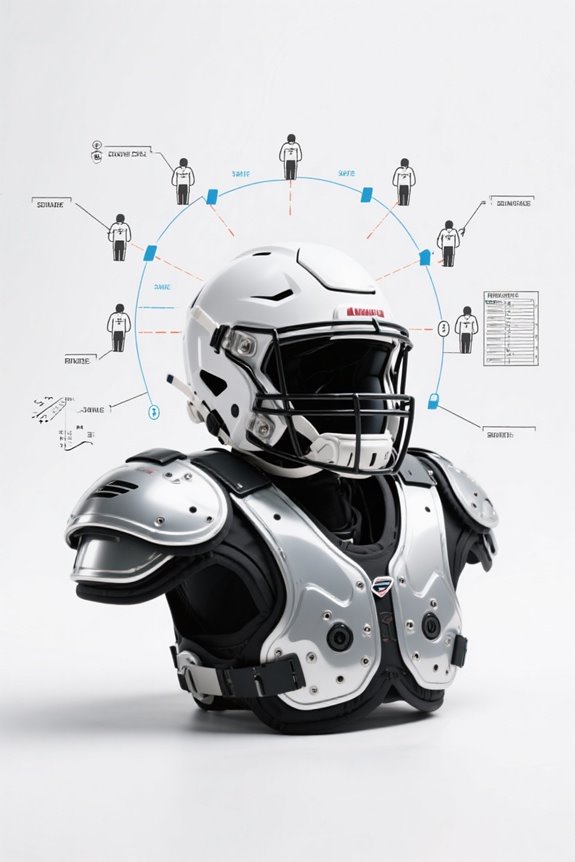
Understanding offensive formations is essential for both players and coaches, as these alignments directly influence the strategies employed during a play. Formation terminology is critical, as names often stem from the alignments of key players, including quarterbacks and running backs. Common categories, such as power and spread formations, shape offensive strategies by dictating run or pass emphasis. The alignment impacts how defenses respond, affecting the responsibilities of players like safeties. For example, the I-Formation emphasizes power running, while the Shotgun enhances passing options, showcasing the importance of formation choice. Ultimately, formations encompass variations that can confuse defenses, highlighting the need for safeties to interpret offensive alignments effectively to anticipate potential plays and adjust accordingly. Additionally, the use of dry erase boards for coaches facilitates clearer communication of these formations during practice and games.
Recommended Products

WALL-MOUNTED WHITEBOARD – Supplied with a robust wall attachment system, this dry erase whiteboard provides ultimate stability and strength. Each board is supplied with wall mounting hardware for quick & easy installation, ensuring that the tactics boards remain securely in place.

DESIGN FOR FOOTBALL: Home/Guest Score, To Go and Ball On up to 99, Quarter up to 9. Clock counts down from 99:59 to 00:00, counts up from 00:00 to 99:59, customizable for the time needed. It will make a beep when score changes and time arrives, the sound can be disabled.

✅ EVERYTHING IS INCLUDED - Includes 1 huge inflatable soccer dartboard, 2 red kick balls, 2 black kick balls, 1 kickball pump, 1 electric air pump for the dartboard, 4 ground stakes, and a reusable dry-erase scorecard with pen.
Key Player Identification
Key player identification is a critical responsibility for safeties, as recognizing the positions and movements of offensive skill players allows for informed decisions during plays. Safeties particularly focus on signal recognition of running backs, tight ends, and slot receivers pre-snap, as each player’s positioning provides insights into the play type. For example, running backs positioned 7+ yards deep typically indicate a run or play-action, while shallow backs suggest passing plays. Additionally, tight ends with wider splits are more likely to run routes, whereas tighter splits suggest blocking roles. By consistently monitoring these factors, safeties effectively anticipate offensive strategies, positioning themselves to counteract the opposing team’s intentions and maintain coverage integrity. Understanding the importance of eye black stickers can enhance a player’s focus and performance on the field.
Recommended Products

CROWN YOUR CHAMPION IN STYLE - Celebrate fantasy football dominance with the TrophySmack 36" Tall, 19-Year Perpetual Championship Trophy – Gold Football—a bold, customized symbol of victory that turns heads and demands respect.

【Instant Game Transitions】 Thanks to its user-friendly swivel design, the game table lets you switch between pool and foosball in seconds, with no need for tools or complicated steps. Simply rotate and lock the tabletop for uninterrupted play while maximizing floor space in your game room.

PRINTED IN MICHIGAN by Underground Printing. Products include an official UGP Hang tag or sticker.
Observing Quarterback Behavior
How do safeties effectively decode the intentions of quarterbacks during a football play? By closely observing quarterback alignment and behavior, safeties can predict play outcomes. They analyze the quarterback’s position and eye movements pre-snap, noting any alignment that hints at intended routes or target areas. A quarterback scanning the field for mismatches often reveals throw intent, which safeties can identify by monitoring shoulder and head positioning. For instance, a high shoulder typically indicates a deep pass, while a low shoulder suggests a shorter throw. Additionally, safeties consider the quarterback’s drop back style post-snap, as variations in rhythm and depth can signal whether a short or deep throw is forthcoming, enhancing their defensive positioning and reaction times. Understanding how girdle padding protection can impact quarterback mobility may also aid in reading a quarterback’s decision-making process.
Eye Discipline Essentials
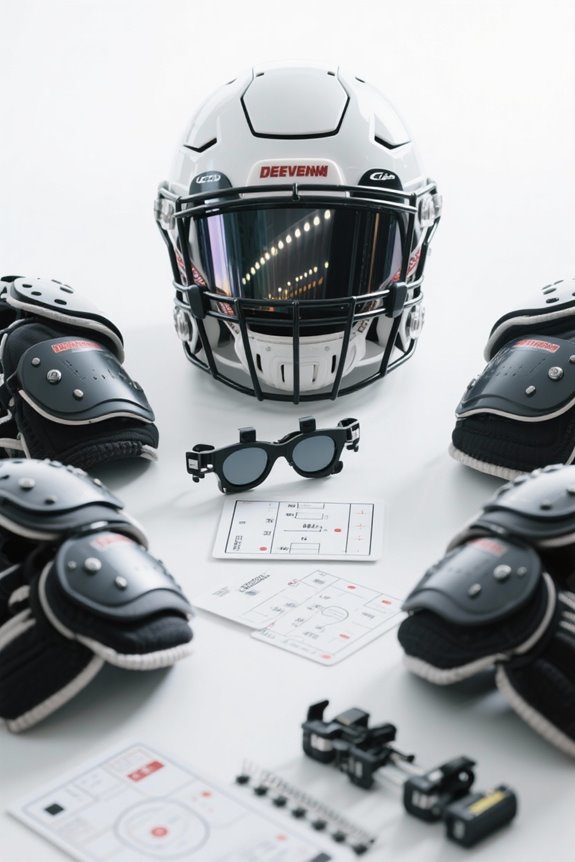
Eye discipline plays a critical role in a safety’s ability to effectively read and react during football plays. Maintaining appropriate eye focus enables safeties to detect offensive cues while preventing deception from initial receiver movements. Discipline training is essential, as safeties adjust their gaze based on coverage types—man, zone, or blitz—all needing distinct key reads. Observing pre-snap formations aids in anticipating the play type. In zone coverage, focusing on the quarterback’s movements rather than locking onto one receiver allows for greater defensive adaptability. This discipline not only aids in anticipating run and pass plays but also prevents exploitation by play-action or misdirection. Eye discipline ultimately synchronizes visual tracking with foot coordination, enhancing overall positioning and reaction capabilities. Incorporating agility ladder drills into their training can further refine a safety’s quickness and decision-making on the field.
Tracking Receiver Movements
Tracking receiver movements is an essential skill for safeties, as it directly impacts their effectiveness in both man and zone coverage scenarios. Safeties must recognize the type of play, such as a pass or run, influencing their reactions to receiver acceleration. Pre-snap motion from receivers provides crucial clues regarding intended route variations and expected coverage. Additionally, analyzing receiver speed is critical; faster receivers may necessitate deeper positioning for safeties. Observing sharp cuts by receivers indicates changes in route direction, prompting immediate adjustments in safety positioning. Moreover, the method of receiver release at the line offers insights into the upcoming route, allowing safeties to prepare effectively for their coverage responsibilities and enhance overall defensive strategy. Incorporating tools that create unpredictable bounces during training can further help safeties improve their reaction times.
Reading Receiver Routes
Reading receiver routes requires a keen understanding of various indicators, allowing safeties to anticipate the offensive players’ intentions effectively. Safeties focus on receiver cues and movement patterns during the initial release. Quick first steps indicate deep routes, while hesitation suggests shorter routes like hitches or slants. The receiver’s body language further informs safeties; a forward lean may signal an imminent route break, while upright posture often points to vertical routes. Recognizing the subtlety of stemming routes also aids safeties in predicting the break point. Understanding the depth and timing of routes helps safeties react promptly to movements, enabling them to maintain effective coverage and respond to offensive strategies with precision and speed. Additionally, the use of tackling dummies during practice can help safeties simulate impacts and improve their training techniques for better decision-making on the field.
Leveraging Offensive Tendencies
While understanding how to read the actions of receivers is essential for safeties, leveraging offensive tendencies greatly enhances their ability to anticipate plays and react effectively. Safeties who meticulously study film can identify key player tendencies and recognize how specific offensive schemes correlate with their quarterback’s preferences. For instance, repeated formations, coupled with an awareness of player alignments, can indicate whether a play is likely to be a run or a pass. Additionally, monitoring cadence patterns allows safeties to predict snap timing, while understanding down-and-distance situations refines their positioning on the field. By focusing on these offensive tendencies, safeties sharpen their instincts, enabling them to make informed decisions that may result in vital defensive plays. Furthermore, the high visibility flags used in flag football can serve as an excellent training tool, helping safeties to enhance their recognition skills during practice.
Recognizing Common Play Concepts
Understanding common play concepts is essential for safeties as they navigate the complexities of modern football. Safeties must excel in route anticipation, keying in on receivers, particularly the No. 2 receiver, to discern route intentions. For instance, vertical routes necessitate safeties matching the receiver deep, while underneath routes like slants and digs require them to adjust coverage. Effective safety positioning is driven by recognizing combinations such as flat-7-4 verticals and flat-slant routes, which inform their responsibilities. Pre-snap cues, including receiver splits and tight end alignments, further enhance their ability to anticipate plays. Thorough understanding of these patterns not only improves coverage skills but also mitigates potential breakdowns during games, underscoring the importance of strong play recognition. Incorporating strength and conditioning into their training regimen can also significantly enhance safety performance on the field.
Reacting to Ball Movement
Reacting to ball movement is a critical skill for safeties, as their ability to respond effectively can substantially influence the outcome of a play. Safeties must focus on ball carrier dynamics, analyzing foot placement and body language to predict potential cuts or direction changes. Recognizing subtle shifts in the ball carrier’s center of gravity is essential. Additionally, tracking the quarterback’s movements, including throwing motion and release point, allows safeties to anticipate possible throws. During action, safeties use pursuit angles to cut off escape routes rather than chasing directly. Adjustments in speed and angle are continuous, requiring a strong balance to react to sudden moves, such as jukes or spins, ensuring they maintain effective tackling positions without compromising defensive integrity. The integration of effective strength conditioning through versatile training techniques can further enhance a safety’s ability to react swiftly and maintain performance during critical moments on the field.
Coverage Responsibilities
Coverage responsibilities play an essential role in a safety’s performance on the football field, as they dictate how effectively the defense can combat offensive strategies. Safeties participate in both zone coverage and man coverage, greatly influencing the overall game. In zone coverage, safeties often cover deep zones, such as in Cover 2, where they split the field, or Cover 3, where one safety guards a deep third. Conversely, in man coverage, safeties frequently match up with tight ends or running backs, requiring agility and discipline to stay with their assignments. A safety’s ability to read offensive formations and adjust accordingly is vital, ensuring they fulfill their responsibilities while maintaining effective communication with teammates for cohesive defensive strategies.
Communicating With Teammates
Effective communication among teammates is essential in football, particularly for safeties, who must quickly assess and respond to dynamic game situations. Verbal clarity is crucial, as safeties use concise phrases like “UP!” or “DROP!” to instruct or alert teammates. This precise linguistic approach fosters coordination among players, enabling a swift response to evolving threats on the field. Additionally, active listening enhances team dynamics, allowing players to receive and validate communication without disruption, which builds mutual trust. Listening attentively enables safeties to adjust their positioning based on teammates’ cues, effectively interpreting plays. Overall, open dialogue and responsive communication not only sharpen individual awareness but also contribute to collective performance, solidifying a cohesive defensive strategy.
Adjusting to Offensive Strategies
Safeties must adeptly adjust to offensive strategies in order to effectively protect their designated coverage areas and respond to evolving plays. Key to this process is the analysis of pre-snap offensive formations and personnel, which informs their adjustment strategies. Recognizing shifts in offensive alignments, as well as tracking quarterback cues, enables safeties to anticipate potential plays and respond swiftly. In addition, post-snap observation of receiver movements and route combinations plays a critical role in adapting to offensive counters, allowing safeties to decide on coverage responsibilities dynamically. By leveraging visual cues, such as quarterback body language and head position, safeties can enhance their ability to react to offensive tactics, ensuring they maintain ideal positioning throughout the game.
Drills for Improving Read Skills
Improving read skills is a vital aspect of a safety’s training regimen, as these skills directly impact their effectiveness in both pass coverage and run support. Training typically includes drill variations such as the Break Step/T-Step Ball Reaction Drill, which enhances quick reactions to passes, emphasizing explosive movements and anticipation. Additionally, route recognition drills simulate real game scenarios, reinforcing discipline in reading receiver routes. Safeties must also practice reading EMOLS blocks for decision-making, while Angle Tackling Drills improve pursuit angles and tackling techniques. Feedback sessions are integral, offering insights to refine performance and address weaknesses in read skills. Collectively, these drills and sessions contribute to enhanced situational awareness, bolstering overall defensive capabilities in gameplay.
Frequently Asked Questions
What Skills Are Essential for Safety Performance Beyond Reading Plays?
Essential skills for safety performance include mastering tackling techniques to effectively stop ballcarriers and possessing strong communication skills to coordinate with teammates, ensuring cohesive defensive strategies during plays and adapting to ever-changing game situations.
How Do Weather Conditions Affect a Safety’s Reading Abilities?
Weather conditions greatly hinder a safety’s reading abilities. Rainy conditions blur vision, snowy conditions reduce mobility, windy games alter ball trajectories, and high humidity levels diminish cognitive functions, complicating essential play recognition and reaction timing.
What Mental Preparations Do Safeties Need Before Games?
Before games, safeties utilize mental visualization to vividly picture game scenarios, enhancing their anticipation of opponent tendencies. This practice builds confidence, improves decision-making speed, and establishes neural pathways for rapid reactions during unpredictable moments.
How Does a Safety’s Role Change With Different Defensive Schemes?
A safety’s role shifts considerably with defensive schemes, shifting between zone coverage and man coverage based on assignments. This flexibility allows them to respond dynamically to offensive formations, enhancing overall defensive strategy effectiveness.
What Impact Does Film Study Have on a Safety’s Performance?
Film analysis greatly enhances a safety’s performance, contradicting the notion that instinct alone suffices. By improving pattern recognition and situational awareness, consistent study leads to performance improvement through quicker decision-making and anticipation of offensive strategies.