As an Amazon Associate, we earn from qualifying purchases. Some links on this site are affiliate links at no extra cost to you. Our recommendations are based on thorough research and editorial judgment.


What Skills Should Youth Football Players Focus On First?

Youth football players should first concentrate on developing technical ball skills, dribbling mastery, and passing accuracy, as these foundational abilities are critical for overall performance. Studies indicate that mastery in passing techniques can enhance game performance considerably. Additionally, ball control and shooting technique should be prioritized to improve scoring opportunities and accuracy. Physical conditioning, agility training, and hand-eye coordination drills are essential for skill enhancement. Further exploration of these skills reveals deeper insights into effective training strategies.
Key Takeaways
- Youth players should prioritize mastering basic passing techniques for improved accuracy and team performance on the field.
- Develop dribbling skills through focused drills that enhance ball control, agility, and spatial awareness.
- Emphasize fundamental defending skills, including proper tackling techniques and defensive positioning for effective gameplay.
- Incorporate physical conditioning exercises, such as speed drills and agility training, to boost overall fitness and reduce injury risk.
- Engage in catching drills to improve hand-eye coordination while fostering confidence through regular practice and measurable goals.
Technical Ball Skills
Technical ball skills are essential in youth football, serving as the foundation for effective play on the field. Mastering passing techniques is vital, as accuracy is a key component in executing plays and enhancing team performance. Youth players should focus on controlling the ball during both short and long passes, which fosters improved muscle memory and timing. Additionally, versatility can be cultivated by training to pass with both feet, increasing adaptability in diverse game situations. Effective ball manipulation is equally important, as it enhances retention under pressure and aids in decision-making speed. Incorporating various drills that simulate game conditions allows players to develop essential skills, such as proper body positioning and foot placement, ultimately boosting overall proficiency on the field. Utilizing tools like football rebounder nets can further enhance practice sessions by facilitating accurate passing and ball control drills.
Dribbling Mastery
Dribbling mastery is an essential component of youth football, as it not only enables players to maintain possession but also enhances their ability to maneuver effectively in dynamic game situations. Fundamental dribbling techniques include mastering ball control, which can be developed through focused dribbling drills such as cone weaving and tight space drills. Engaging in varied drills, like the cone stop-and-go, enhances agility and footwork diversity, promoting the use of both feet and different parts of the foot. Additionally, drills that emphasize direction changes, such as the square drill, cultivate sharp turns necessary for avoiding defenders. Overall, consistent practice of these dribbling drills fosters spatial awareness, builds confidence, and prepares youth players for real-game challenges, ultimately improving their playing ability. Incorporating target pockets in training sessions can further enhance a player’s precision and accuracy during gameplay.
Passing Accuracy

While many elements contribute to a player’s success in youth football, passing accuracy stands out as a critical skill that greatly influences overall game performance. The effectiveness of training methodologies, such as the Pass Go methodology, has demonstrated significant improvements in short-range passing accuracy, boasting a 24.3% enhancement over traditional drill training. Game situations reveal that younger players particularly benefit from game-based training, yielding a 64.3% increase in decision-making speed. In addition, passing accuracy is essential for successful tactical passing strategies, as players across all age groups tend to rely heavily on short passes, especially in midfield zones. Ultimately, a robust passing ability correlates with heightened performance in small-sided games, underscoring its value in youth football development. Furthermore, ensuring proper impact protection through adequate padding can also enhance player safety during practice and games.
Recommended Products

Jugs Football Passing Machine throws precise passes, punts, and kickoffs to any spot on your field.

Jugs Field General Football Machine throw accurately from 5 to 60 yards, allowing you to hit receivers in stride, running any route in playbook

REALISTIC QUARTERBACK PASSES: Launches accurate spiral footballs at adjustable speeds and trajectories to simulate game-like passing drills for quarterbacks, receivers, defensive backs, and special teams practice.
Ball Control

Ball control represents a foundational skill in youth football, essential for effective gameplay and overall development. Mastering ball control begins with exercises such as toe taps, which enhance rhythm training and sensitivity to the ball. Alternating touches develop foot coordination, permitting players to refine their technique. Drills like inside-outside touches and back-and-forth taps not only enhance balance but also promote a greater level of spatial awareness. Initially focusing on stationary drills allows for a comfortable grasp of technique, before progressing to dynamic movements that simulate game situations. Incorporating challenges, like timed drills, fosters decision-making under pressure. Consistent practice builds muscle memory, allowing players to efficiently execute advanced ball mastering skills, which are crucial for success on the field. Additionally, enhancing catching skills can significantly contribute to a player’s overall performance and confidence in gameplay.
Recommended Products

PREMIUM BUILD FOR MAXIMUM DURABILITY – Designed with a 42mm round galvanized steel frame, 2mm thick walls, and a heavy-duty 3mm braided net, this goal is built to withstand tough conditions and powerful shots, ensuring long-lasting use for backyard fun or serious training.

3-IN-1 SOCCER REBOUNDER NET & GOAL This 3-in-1 soccer training equipment combines a practice soccer goal net, a high-tension soccer rebounder net (for volleys), and a low-angle soccer passing board (for control). Purpose-built for total skill development.

Complete Adjustable Agility Kit for All Sports: This adjustable agility poles set is a must-have for soccer, rugby, and basketball training. The set includes 6, 10, or 20 sticks, making it ideal for coaches, youth, and kids to improve footwork, speed, and practice drills across multiple sport scenarios
Shooting Technique
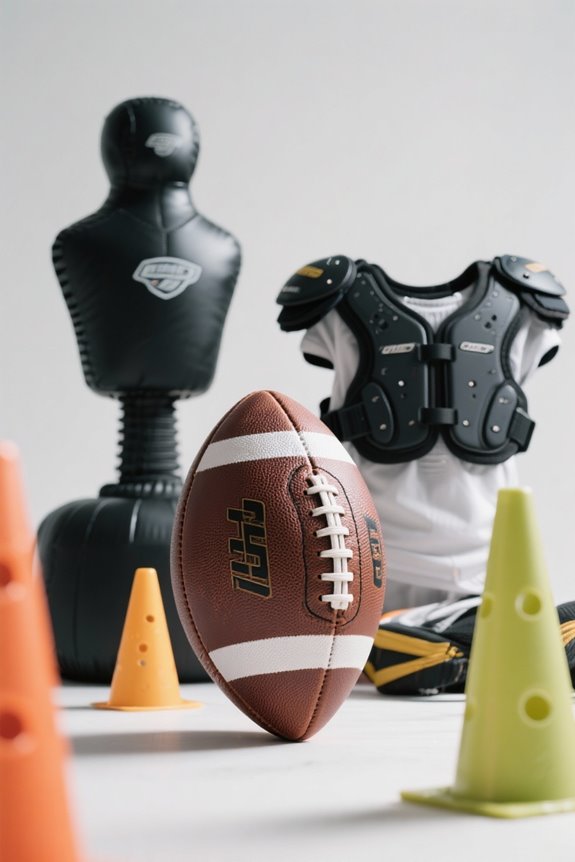
Shooting technique is a critical skill in youth football that greatly influences scoring opportunities during matches. Developing proper mechanics involves planting the supporting foot beside the ball for stability, striking with the laces, and following through in the shot’s direction. These elements are essential for maximizing shooting accuracy and power. Engaging in targeted shooting drills can refine these mechanics, as young players practice quick shots and placement under pressure. For instance, one-on-one shooting drills enhance accuracy and decision-making. Coaches should prioritize repetition in unopposed conditions before introducing defenders, ultimately fostering confidence and effective shot execution. Additionally, encouraging players to scan the field improves tactical awareness, considerably increasing the likelihood of scoring in competitive situations. Incorporating tools like football blocking dummies can further enhance practice by simulating defensive pressure during shooting drills.
Recommended Products

VISUALIZE THE GOAL. Goal shot does things cones, targets and stand-in goalies can't do: it creates visual focus on the specific zones where players are four times more likely to score.

TRAIN LIKE THE PROS: The Designated Hitter Pro is the ideal pitcher's training tool for baseball and softball pitchers at the advanced level and allows you to simulate a live training or more realistic bullpen session for your pitcher without the need for a live batter

VERSATILE: Serves as both step-over dummy for agility drills and blocking/tackling dummy for contact training
Basic Defending Skills
Defensive skills are essential components of youth football that underpin team success, with effective defending reducing scoring opportunities for opponents. Youth players must learn proper tackling technique, emphasizing shoulder-first contact and maintaining a low, balanced stance. This approach not only enhances player safety but also maximizes tackling effectiveness. In addition, defensive positioning is vital; defenders should understand their leverage based on the specific defensive scheme employed. Employing drills that focus on angle tackling and gang tackling can considerably improve a team’s defensive cohesiveness and reaction to offensive plays. Moreover, practicing footwork, such as lateral shuffles and backpedals, enhances a defender’s mobility, enabling quick responses to the ball carrier’s movements during the game, thereby reinforcing foundational defensive skills. Additionally, utilizing tackling dummies in training sessions can further enhance skills by allowing players to practice safe and effective techniques.
Recommended Products

GREAT FOR ANY LEVEL: These tackling dummies for football help Adult and Youth players develop the proper tackling techniques.

Material and Size: taking into consideration the football dummy's quality, you'll find it's made of quality PVC sandwich cloth and filled with a high density sponge, ensuring it can withstand intense training; Measuring around 42 x 12 x 6 inches, this step over dummy football presents the ideal size for realistic training

Versatile tackling dummy and step over dummy perfect for football, basketball, kickboxing, martial arts and other sports training.
Cognitive and Tactical Awareness
In youth football, cognitive and tactical awareness encompasses the ability to read the game, anticipate movements, and make informed decisions under pressure, skills that are essential for players’ overall performance. Research indicates that football training enhances attention, inhibitory control, and working memory in young athletes, contributing to improved cognitive flexibility. Players who develop tactical decision-making can better interpret movements and respond appropriately in real-time scenarios. Effective training should involve engaging scenarios that promote independent problem-solving, as challenges enhance cognitive skill acquisition. Moreover, systematic exposure to unpredictable game conditions aids in refining players’ anticipation and composure, factors distinguishing elite from sub-elite participants. Therefore, prioritizing cognitive and tactical development is fundamental for aspiring youth football players. Incorporating drills that focus on reaction time and accuracy can also significantly boost performance in competitive settings.
Physical Conditioning and Footwork
Physical conditioning and footwork are vital components in the development of youth football players, complementing the cognitive and tactical skills previously discussed. Effective conditioning programs incorporate speed drills, agility training, and endurance exercises to enhance overall athletic performance. Key speed drills, such as sprint intervals and hill sprints, develop explosive power, while agility techniques like ladder and cone drills improve quickness and coordination. Endurance training, including long-distance runs and high-intensity interval training, is essential for sustaining energy throughout games. Additionally, strength conditioning exercises build muscle mass and core stability, contributing to overall physical resilience. Emphasizing these foundations guarantees that young athletes not only improve their skills but also reduce the risk of injuries, thereby enhancing their long-term participation in the sport. Incorporating football speed ladders can significantly improve agility and footwork, crucial for excelling in games.
Position-Specific Skills
While mastering general skills and athleticism forms the foundation of youth football, developing position-specific skills is equally critical for maximizing each player’s potential on the field. Quarterbacks must prioritize quarterback mechanics, focusing on accurate and consistent throwing and reliable snap-taking. Running backs benefit from enhancing running back agility and developing strong ball-carrying techniques while effectively reading blocking schemes. Wide receivers require route-running precision and effective blocking skills to excel in their positions. Offensive and defensive linemen should emphasize lineman strength through proper stances and footwork to control opponents, while defensive backs must enhance their coverage techniques, improving backpedal and hip-turn mechanics. Additionally, utilizing target areas and design in training equipment can significantly enhance skill development and performance on the field. Emphasizing these skills not only fosters individual excellence but also cultivates cohesive team performance.
Hand-Eye Coordination and Catching
Hand-eye coordination serves as an essential component in the development of catching skills for youth football players, as it directly influences their ability to track and secure the ball during play. Effective catching drills that emphasize visual tracking, such as following colored balls, can enhance a player’s capacity to anticipate ball trajectory. Incorporating varied ball sizes in practice not only challenges adaptability but also helps athletes focus on different techniques. Utilizing stationary tosses before progressing to moving catches aids in developing dynamic coordination. Additionally, implementing unpredictable reaction drills simulates real-game scenarios, improving athletes’ readiness. Frequent practice, ideally three times a week, alongside measurable goals, guarantees consistent improvement in hand-eye coordination and catching ability, vital for on-field performance. Using tools like football accuracy nets can further enhance players’ throwing precision and overall skill development.
Core Skill Development and Confidence Building
Core skill development and confidence building are essential in the growth of youth football players, as these elements directly impact their long-term success on the field. Implementing self-regulation strategies and resilience training enhances players’ psychological characteristics, which are vital for achieving ideal development outcomes. Age-appropriate challenges promote cognitive and emotional growth, allowing players to build confidence through incremental skill progression. A supportive environment additionally fosters mental well-being, encouraging adaptability and continuous learning. Coaches’ effective engagement in structured practices enhances players’ motivation, instilling perseverance and psychological readiness. Moreover, building character through football training greatly contributes to self-esteem and confidence both on and off the field, ultimately leading to a more robust foundation for future athletic endeavors.
Frequently Asked Questions
How Can I Choose the Right Position for My Child in Football?
To choose the right position for a child in football, assess their physical attributes and skills. Consider position characteristics such as speed, strength, and game awareness to match them effectively with appropriate roles on the team.
What Age Is Best for Starting Youth Football Training?
Ah, the ideal football training age—a whimsical age of three! While young ones kick and giggle, early skill development shapes boundless joy. Perhaps if only adults could master fun, football would flourish at any age!
How Often Should Youth Players Practice Their Skills?
Youth players should practice their skills multiple times per week, ideally daily for effective skill development. Short, focused sessions enhance practice frequency, promoting ball mastery while ensuring engagement and reducing fatigue throughout training activities.
What Are Signs of Overtraining in Young Football Players?
Forty percent of young athletes report fatigue symptoms linked to overtraining. Signs include chronic pain, mood changes, and performance decline. Effective recovery strategies involve balanced training, adequate rest, and monitoring for mental and physical health indicators.
How Can Parents Best Support Their Child’s Football Development?
Parents can support their child’s football development by encouraging practice techniques and providing nutrition guidance. Ensuring a balanced diet and promoting effective practice habits help foster skill enhancement and overall athletic growth in young players.


