As an Amazon Associate, we earn from qualifying purchases. Some links on this site are affiliate links at no extra cost to you. Our recommendations are based on thorough research and editorial judgment.


What Is The Two-Minute Warning In Football?

The two-minute warning in football marks a critical moment, occurring when the game clock reaches two minutes in each half. This stoppage allows teams to regroup strategically, providing approximately 15.5 extra seconds for play organization. In the NFL, the clock automatically halts at this point, with potential 10-second runoff penalties for defensive infractions. This tradition, established in 1942, influences tactical decisions considerably. To better understand its historical context and implications on gameplay, further exploration reveals additional dimensions of this phenomenon.
Key Takeaways
- The two-minute warning is a stoppage in NFL games that occurs when the game clock reaches two minutes in the 2nd and 4th quarters.
- It serves as a strategic planning point, providing teams with an additional 15.5 seconds to organize plays before resuming action.
- The clock stops automatically at the two-minute warning and resumes only after the next snap, enhancing in-game tactics.
- A potential 10-second runoff penalty may apply if a defensive penalty occurs, emphasizing clock management and strategy during this critical time.
- The NCAA plans to implement a similar “two-minute timeout” in 2026, aligning college football rules with the NFL’s standards.
Origin and Definition of the Two-Minute Warning
The two-minute warning in football serves as a pivotal moment in the game, originating in the early years of the National Football League (NFL), when precise timekeeping was handled by officiating crew members equipped with personal timepieces. Its historical significance lies in providing teams with an official notification of the time remaining in each half, particularly essential during late-game scenarios when game mechanics are most intense. Initially, the warning acted as a straightforward timekeeping checkpoint, allowing teams to strategize effectively. Over time, despite advancements like the stadium clock’s adoption as official time, the tradition of the two-minute warning has endured, evolving into a significant moment for tactical planning and enhancing the overall viewing experience within the sport. This moment often leads to engaging drills aimed at maximizing player performance during critical game situations.
Rules and Timing Specifications
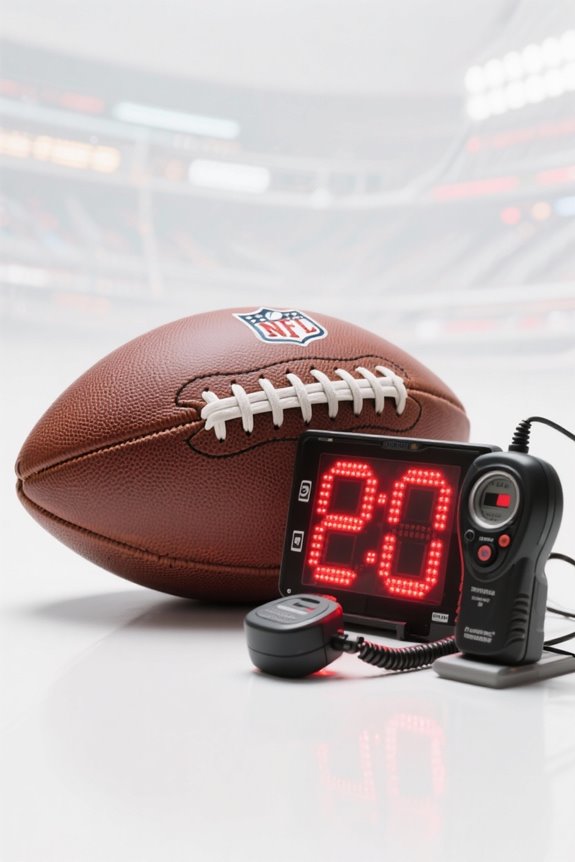
Serving as a potential game-changer, the rules and timing specifications of the two-minute warning are critical for teams as they approach the conclusion of each half. This rule, deeply rooted in professional football since 1942, triggers when the game clock hits 2:00, with specific nuances governing its application. The clock stops automatically, allowing teams to strategize, while the game clock resumes only upon the next snap, not at the ready-for-play signal. In adapting to this, NCAA football will implement a similar rule in 2026, standardizing timing across levels. Additionally, post-warning situations may invoke 10-second runoff penalties in the NFL to hinder time manipulation, illustrating how timing nuances profoundly influence teams’ tactical decisions during critical game phases. Understanding the importance of safety features in football gear also plays a vital role in ensuring player performance amidst intense situations like the two-minute warning.
Recommended Products

Comfortable and Breathable: Slim Fit. Crafted from ultra-soft fleece fabric, this electric jacket offers comfort for daily wear or as an alpine mid-layer. Moisture-wicking and temperature-regulating, keep you dry. The stand-up collar protects against wind, while elastic cuffs and hem ensure a snug, flexible fit to seal in warmth.
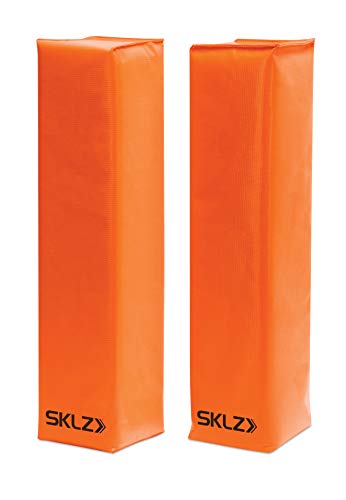
High visibility, durable end zone pylons used to mark the edges of the football playing field

Learn to catch with the fingertips instead of the palms
Purpose and Strategic Impact
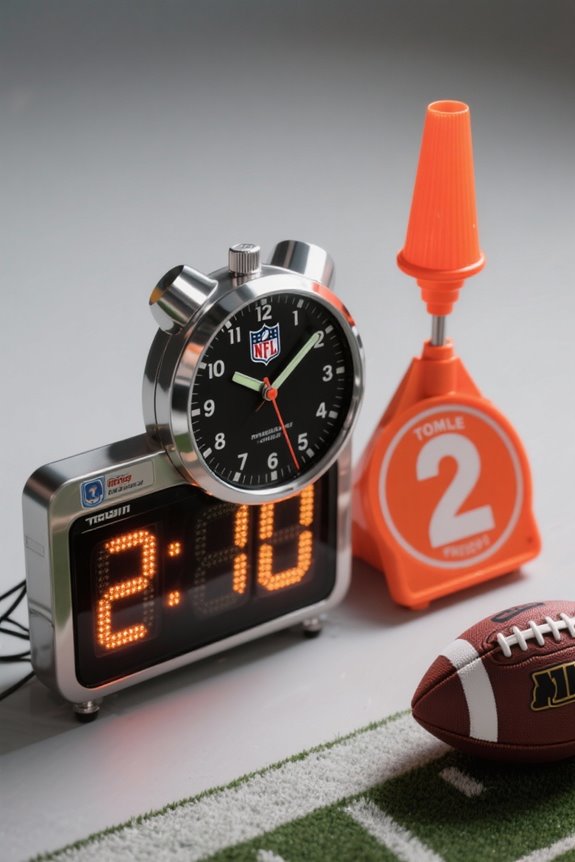
While the two-minute warning in football serves as a vital juncture in games, its strategic impact extends far beyond merely stopping the clock. This stoppage functions as an additional tool for game management, allowing offenses approximately 15.5 extra seconds to organize and execute plays. By providing teams a “free” timeout, the two-minute warning enhances offensive strategy, enabling precise control in late-game scenarios, particularly during comeback attempts or nestled towards securing victories. Additionally, it disrupts defensive momentum, compelling opponents to modify their tactics accordingly. The warning raises the significance of clock awareness and situational football skills, emphasizing essential decision-making moments and, ultimately, influencing the outcome of tightly contested games. Moreover, effective strength training approaches employed in a team’s preparation can substantially enhance performance during these critical game situations.
Recommended Products

Trains players to stay low and keep a wide stance

Material and Size: taking into consideration the football dummy's quality, you'll find it's made of quality PVC sandwich cloth and filled with a high density sponge, ensuring it can withstand intense training; Measuring around 42 x 12 x 6 inches, this step over dummy football presents the ideal size for realistic training

VERSATILE DUMMY FOR SPORTS TRAINING - Step Over Dummy Perfect for Footwork Drills for a Variety of Sports Including Football, Soccer, and More
Differences Between NFL and NCAA
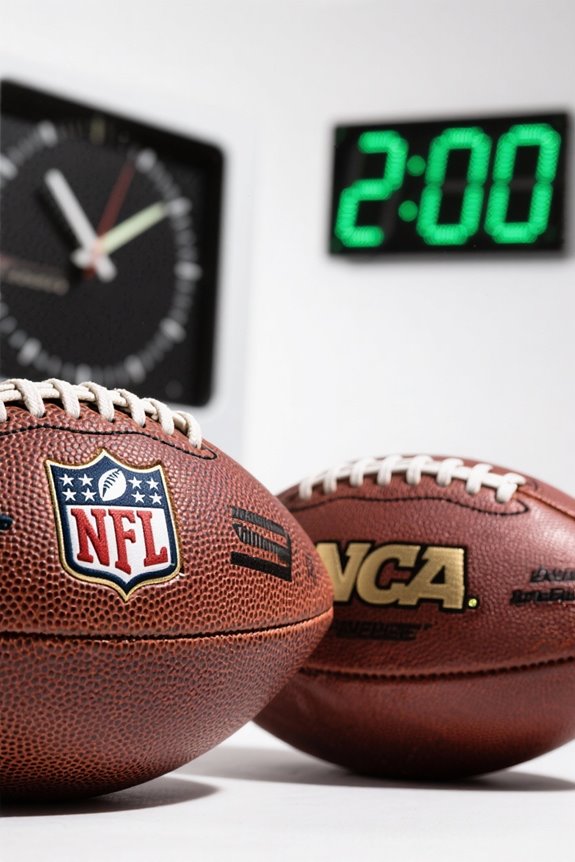
Differences between the NFL and NCAA regarding the two-minute warning and its implementation reflect divergent approaches to game management and timing protocols. The NFL’s two-minute warning occurs precisely at the two-minute mark of the 2nd and 4th quarters, stopping the clock if the ball is dead, while the NCAA introduced a “two-minute timeout” in 2026 to standardize timing within its games. This timeout, initiated when the ball is not live, aims for two-minute synchronization and allows teams to make tactical adjustments. Additionally, the NFL’s terminology as “warning” emphasizes its historical significance, contrasting with the NCAA’s “timeout,” which underscores a formal stoppage. Both leagues pause the clock, providing teams an opportunity to regroup strategically as the end of each half approaches. This strategic advantage is further enhanced by essential tackle football equipment that supports effective athlete development during crucial game moments.
Recommended Products

Gear ratio - 5.2:1; Drag - 45 lb
TALICA 20II

Football's first ever position-specific helmet, engineered for reducing linemen's repetitive, low velocity helmet impacts
Media and Broadcast Considerations
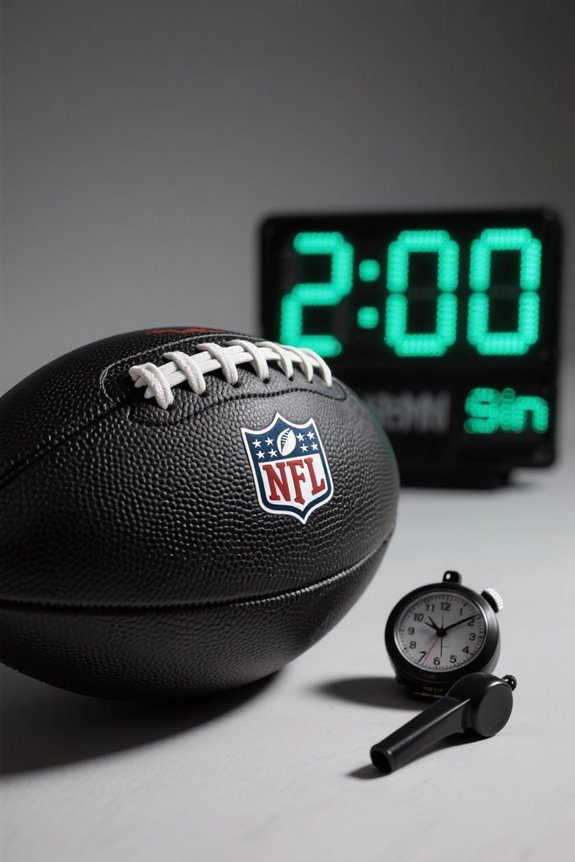
In recent developments, media and broadcast considerations surrounding college football have evolved with the introduction of the two-minute timeout, an initiative designed to enhance game management and advertising synchronization. The NCAA mandates that networks reserve at least one media timeout aligned with this stoppage, creating predictable opportunities for commercials. This structure improves broadcast synchronization, avoiding back-to-back media timeouts that disrupt pacing. Utilizing advanced timing technology, broadcasters can efficiently manage commercial breaks while maintaining game flow. Additionally, the distinct term “two-minute timeout” differentiates it from the NFL’s “two-minute warning,” reflecting media sensitivity to brand associations. These changes improve clarity, ensuring smoother shifts during televised games and providing a more organized experience for viewers and networks alike. Players must wear compliant gear such as football gloves that meet safety standards to further enhance their performance on the field.
Historical Context and Evolution
A thorough understanding of the two-minute warning in football requires examining its historical context and evolution within the sport. Originating in the early NFL years, this warning was a significant checkpoint for teams as officials maintained manual control of game time. The historical significance of the two-minute warning transformed with the AFL’s official recognition of stadium clocks in the 1960s, followed by the NFL’s adoption, reflecting technological evolution trends in game management. Additionally, the rise of televised broadcasts turned the two-minute warning into a strategic commercial break, enhancing viewer engagement. Over time, adaptations in college football and high school leagues have modified the warning’s implementation, underscoring its integral role in game tempo and procedural rules. This evolution parallels advances in impact absorption capabilities that enhance safety during high-stakes moments in games.
Impact on Game Strategy
As the two-minute warning approaches, teams in football are prompted to reassess their game strategies, recognizing its considerable impact on both offensive and defensive tactics. The automatic stoppage of the game clock considerably alters coaching strategies, compelling offenses to execute more meticulous play designs. Offensive drives, on average, take approximately 15.49 seconds longer post-warning due to increased clock management complexity. Coaches often utilize the two-minute warning as a strategic tool, akin to a timeout, allowing for brief preparations. During this critical time, teams tend to adopt more conservative play-calling approaches, favoring safer plays to preserve both clock and field position. This shift influences not only offensive dynamics but also defensive strategies, as defensive teams must adapt to rapid offensive changes. Additionally, understanding the importance of ventilation and hygiene can influence preparation and gameplay, ensuring players remain focused during these critical moments.
Recommended Products

IMPROVE QB TIMING & REACTION SPEED: Train like game speed with a programmable timer and loud audible buzzer that simulates real snap cadence. Builds quarterback timing, rhythm, and reaction speed for improved game-day performance.

INFLATABLE DESIGN: Half the cost of foam step over dummies, with the same functionality & durability; Great for agility training at home or on the field; Pre-weighted with 4 lbs of sand, measures 48 x 18 x 10 inches (LxWxH)

WRISTBAND PLAYBOOK - Lead your team to victory with the WristCoaches quarterback wristband (5 Pack). Run the offense like a pro while you call deep balls, play-action passes, screens, or go for the RPO. Put defenses on skates as you skillfully execute big plays!
Timing Rule Changes and Adjustments
Timing rule changes and adjustments have markedly evolved in football, particularly with the introduction of the two-minute warning. Originally established when officials tracked game time, the warning has transformed into a fundamental element of strategic play. In the early 1960s, the AFL adopted stadium clocks for official timekeeping, prompting the NFL to follow suit. This shift diminished the need for warnings but allowed the two-minute intermission to function as a commercial break and key gameplay pause. Subsequent rule evolution has seen the NCAA implement a “two-minute timeout” for enhanced clock visibility, while Texas high school leagues adopted similar rules reflecting NCAA modifications. The integration of special timing protocols during this period enhances fairness and strategic depth in late-game scenarios. Additionally, the emphasis on player safety in coaching ensures that players remain focused on the game without unnecessary risks during these critical moments.
Recommended Products

【Easy to Control】One console control two shot clocks, 330ft control distance. It has the functions of 24/14sec, custom XX seconds from 0-99, reset, start, pause and save data. Last 5 seconds accurate to 1/10 second, high timing accuracy, using single-chip microcomputer control.

Champion Sports Champion Sports Timers

FOR A SPORTY WAKE-UP - Start the day with energy with our unique night light alarm clock. Let the American Football light up when you press it, creating a captivating experience.
Special Cases and Exceptions
While the two-minute warning serves as a critical component of football strategy, its application introduces special cases and exceptions that can considerably impact game dynamics. For instance, during overtime periods, the two-minute warning functions similarly to those in regular quarters, allowing teams a strategic break. Significantly, specific exhibitions may implement the two-minute warning at the end of every quarter, showcasing unusual applications of the timing rule. In addition, unique clock management rules govern the two-minute warning, triggering stricter penalties and potential ten-second runoffs. Understanding these special scenarios helps teams adapt their strategies effectively, maneuvering complex game situations. Ultimately, these exceptions highlight the importance of the two-minute warning in maintaining fairness and enhancing tactical gameplay during critical moments. Additionally, teams may benefit from utilizing customizable strategies to effectively navigate the heightened pressure introduced by the two-minute warning.
Miscellaneous Facts and Statistics
The two-minute warning is a pivotal aspect of football that greatly influences gameplay and strategies. Established in 1942, this stoppage occurs at exactly two minutes remaining in the second and fourth quarters, effectively marking about 4% of a standard quarter. The two-minute statistics reveal that teams prioritize strategic planning during this critical juncture, as coaches adjust plays to maximize scoring while managing their remaining timeouts. Additionally, the two-minute warning increases game intensity, alerting players, coaches, and viewers that critical decisions loom. Moreover, defensive penalties in this window can incur a 10-second runoff, emphasizing the importance of precision. As college football mirrors these rules starting in 2026, similar tactics and strategies will evolve, influencing game flow considerably. Coaches must also consider the importance of mental training during this phase, as maintaining focus can significantly impact the outcome in high-pressure situations.
Future of the Two-Minute Warning in Football
Football’s two-minute warning has evolved considerably since its inception, influencing competitive strategy at various levels of the sport. Upcoming regulatory changes indicate that the two-minute warning, now adopted in high school and college football, will continue to align with existing professional standards. Future innovations are likely to introduce technology that enhances communication during these critical moments, optimizing play-calling strategies. Additionally, the implementation of synchronized media timeouts closely paired with the two-minute warning will maintain game flow while preserving strategic depth. The rule’s evolution emphasizes enhancing player safety, competitive integrity, and improving overall game dynamics. As teams adjust their strategies around this pivotal point, the two-minute timeout will remain a significant aspect of late-game management and timer control.
Frequently Asked Questions
How Did the Two-Minute Warning Affect Game Play in the Past?
The two-minute warning revolutionized game strategy, creating an exhilarating chess match between offenses and defenses. This critical stoppage intensified clock management, enabling calculated plays and dramatic momentum shifts, ultimately shaping unforgettable moments in football history.
Can Teams Challenge Plays After the Two-Minute Warning?
Teams can challenge plays after the two-minute warning, but challenge regulations restrict options considerably. Play reviews are largely overseen by officials, reducing the need for team-initiated challenges during this vital period of the game.
Is the Two-Minute Warning the Same in All Football Leagues?
Ironically, while the two-minute warning symbolizes urgency, it varies considerably across football leagues. International football, NCAA, and Texas high school variants reveal contrasting rules and terminologies, creating a humorous tapestry of league variations and interpretations.
Does the Two-Minute Warning Apply During Overtime Periods?
The two-minute warning does apply during overtime periods, providing teams with an essential pause for strategy. This automatic timeout occurs when the game clock reaches two minutes, influencing play calling and time management considerably.
Are There Penalties Enforced During the Two-Minute Warning?
Yes, penalties are enforced during the two-minute warning, affecting penalty timing and introducing significant strategy implications. Teams must navigate penalties carefully to manage both clock time and their chances of success in critical game moments.


