As an Amazon Associate, we earn from qualifying purchases. Some links on this site are affiliate links at no extra cost to you. Our recommendations are based on thorough research and editorial judgment.

How Do Downs Work In American Football?

In American football, a down represents an attempt by the offense to advance the ball ten yards within four attempts. If the offense fails to gain the required yardage, they lose possession through a turnover on downs. Each series begins at first down, with the line of scrimmage marking the starting point for plays. Coaches strategically evaluate fourth down options, balancing risks and possible penalties. This foundational aspect profoundly influences game dynamics and scoring opportunities, revealing more complexities upon further analysis.
Key Takeaways
- A down is an attempt by the offense to advance the ball, with four downs to gain 10 yards for a new first down.
- The line of scrimmage marks the starting point for each play and requires offensive players to line up closely.
- Success in gaining the required yardage resets the down count while failure results in a turnover on downs.
- Fourth down decisions involve strategic choices, such as punting or attempting a field goal, depending on field position and game situation.
- Penalties can impact down and distance status, affecting how teams strategize their plays and manage possession.
Understanding the Concept of Downs
In American football, the mechanics of downs serve as a fundamental component of the game’s structure, dictating the offensive team’s movements and strategies. A down is fundamentally an attempt by the offense to advance the ball, with each possession starting at the first down and requiring a gain of 10 yards to reset the count. Teams typically have four downs to achieve this objective, thereby emphasizing effective down dynamics in their offensive strategy. Successful yardage advances enable teams to maintain possession and extend drives, while failure leads to a turnover on downs. This tactical element remarkably influences game management, as decisions on fourth down can determine play actions that impact field positioning and potential scoring opportunities. In addition, the necessity for durable equipment, such as high-quality flag football belt sets, can enhance gameplay experience by ensuring smooth operation during both practice and competitive situations.
The Line of Scrimmage Explained

The line of scrimmage represents a critical reference point in American football, as it dictates the starting position for each play and serves as the dividing line between the offensive and defensive teams. This imaginary transverse line signifies the boundary where the football is placed and must remain stationary until the snap. Proper offensive positioning mandates that at least seven players line up closely to this line, including two eligible receivers. In contrast, the defense must hold a position one yard behind the neutral zone until the snap occurs. Violating these protocols can result in penalties, emphasizing the line’s significance in maintaining a fair and regulated play environment. Overall, the line of scrimmage is integral to both offensive and defensive strategies, as it interacts closely with integrated padding designs to ensure player safety during dynamic gameplay.
Down and Distance Terminology
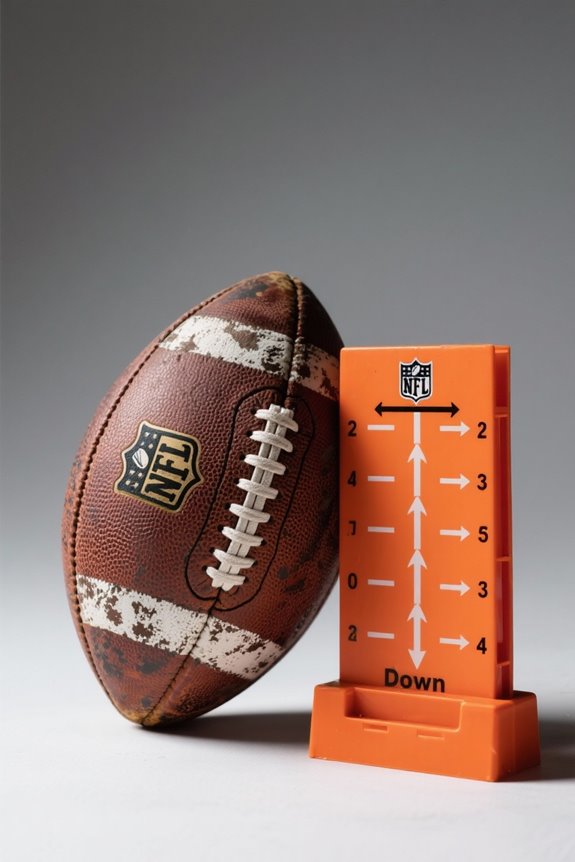
Understanding down and distance terminology is pivotal in comprehending the dynamics of American football plays. The term “down” refers to each attempt by the offense to advance the ball, while “distance” specifies the yardage needed for a new first down. Typically, teams face “first and 10,” meaning they must gain 10 yards to reset their down count. The down strategy plays a critical role in shaping gameplay; teams must adapt their choices based on yardage achieved or lost. Additionally, each play updates the down and distance, necessitating strategic decisions. This terminology aids in evaluating risks versus rewards, as maintaining progression through downs can be essential for offensive success and game momentum. Effective teams often incorporate various strategies in their play calling to enhance their chances of success on each training application.
Recommended Products

DOWN INDICATOR: Use this 6’10” football down indicator to clearly show which down it is all game long.

Multi-Sport Design | Great for Any Cardio or Workout Activies | Easy Fits Under Loose Fit Shorts or Skirts

SUPERIOR DESIGN: 70 Denier Invista LYCRA for Certified Gradient Compression | Medical circular 360 degree knit construction creates a consistent yet powerful pressure
Advancing the Ball for First Downs
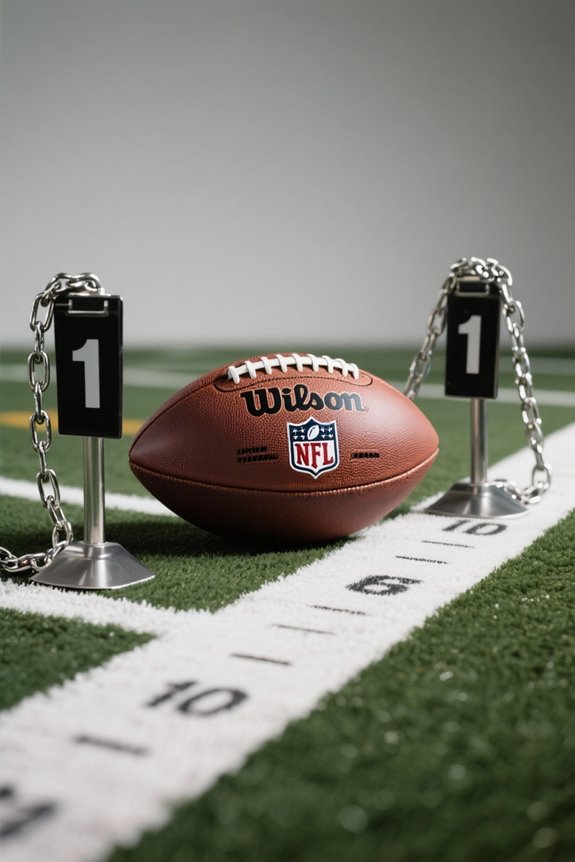
To achieve a first down, an offense must advance at least 10 yards from the original line of scrimmage within a series of four plays, utilizing careful strategic planning and execution. The offense employs various first down strategies, including rushing plays, where players run with the ball, and passing plays, where the quarterback throws the ball forward to advance yardage. If successful, the offense resets with a new set of downs. The spot of the next play is determined by the ball’s forward progress, marking where the ball carrier is halted, ensuring fair placement. Conversely, failure to gain 10 yards within the four attempts results in a turnover or a punt, considerably impacting game momentum and strategy. Additionally, proper visibility of field markers ensures that players can effectively gauge their positioning during plays.
Recommended Products

Vinyl covered foam with weighted bottom

SET INCLUDES: Two 15" foam bull's eyes on padded 7'6" poles with orange padded banners, an orange 10-yard chain with adjustable stainless steel clips, and a 6’ 10” down indicator with orange foam padding.

✔️ EASY INSTALLATION - Effortlessly set up your field with ProLine markers. Simply use the starter tool to make holes and insert the markers, then use the included layout cord to outline your field for consistent markings year after year.
Strategies for Fourth Down Decisions
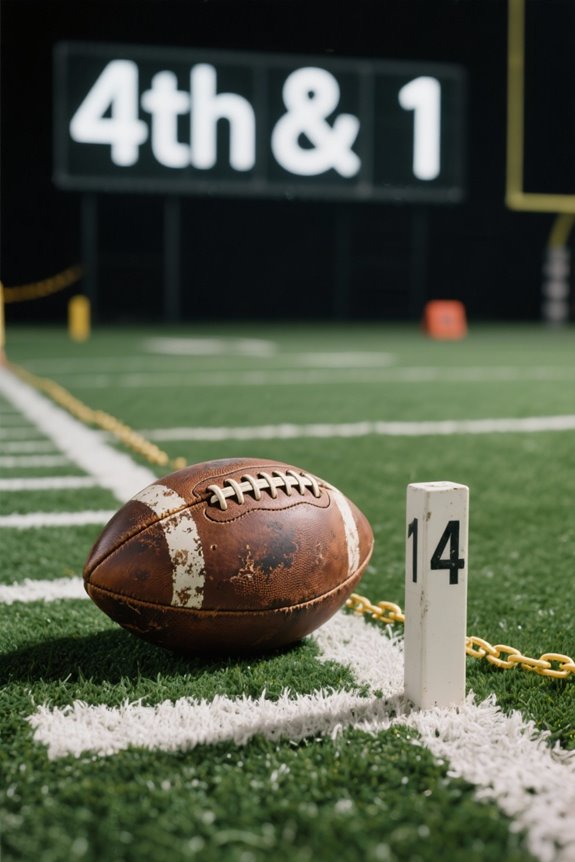
Handling fourth down scenarios in American football requires a nuanced approach, as teams must weigh the potential advantages of aggressive play against the risks associated with failure. Ideal fourth down choices aim to maximize estimated win probability, with options including punting, attempting a field goal, or going for a first down through conversion attempts. Advanced models assess various factors, such as score, yards to gain, field position, and remaining time, to inform these decisions. Despite data supporting aggressive strategies, NFL coaches often exhibit conservative tendencies, preferring to punt rather than take calculated risks. Empirical research demonstrates that making more aggressive fourth down decisions could considerably enhance expected points and overall win probability for teams, shifting outcomes in tightly contested games. Additionally, employing strategic plays and formations can greatly influence a team’s decision-making process on fourth down situations.
The Impact of Penalties on Downs
Penalties in American football greatly influence the dynamics of downs, often altering the strategic options available to both the offense and defense. Penalty enforcement plays an essential role, as many defensive penalties lead to automatic first downs, benefiting the offense despite yardage gained. For instance, penalties like pass interference or defensive holding usually grant a fresh set of downs. Conversely, offensive setbacks from penalties such as false starts result in loss of down, complicating the path to conversion on subsequent attempts. The positioning of the ball is also affected, with defensive penalties moving the offense closer to the goal line, while offensive penalties push them backward. These varying consequences notably shape defensive strategies and offensive play-calling throughout the game. Additionally, understanding the flag football set features can provide insight into how different gameplay dynamics might play out in modified formats.
Measuring Downs: Traditional vs. Technology
Measurement of downs in American football has historically relied on a traditional chain gang system, which employs physical markers to determine the necessary 10-yard gain for a first down. This system utilizes chain measurements, whereby officials place a chain between two poles on the sideline, allowing them to assess whether the offense has advanced the ball sufficiently. However, beginning in 2026, the NFL will replace this method with Sony’s Hawk-Eye virtual technology, which utilizes multiple high-definition cameras to track the football’s position relative to the first down line. This shift aims to expedite measurement times and enhance accuracy, reducing the timing from up to 70 seconds with chains to approximately 30 seconds, hence enabling more efficient game flow and decision-making. Implementing such technology could have implications similar to how football sleds enhance training performance through precision and reliability.
The Importance of Accurate Spotting
Accurate ball spotting plays an essential role in American football, directly influencing the determination of first downs and the overall flow of the game. Precise ball placement is important, as it establishes whether the offensive team has gained the necessary yardage. Officials are tasked with determining the exact moment a player’s body touches the ground to assess where the play concludes. The foremost tip of the football serves as a crucial reference point for yardline alignment, enhancing the measurement’s clarity and consistency. Any errors in official judgment can result in incorrect first down calls, disrupting game momentum and strategic execution. Ultimately, accurate ball spotting reinforces the integrity of the game, ensuring fairness in possession and down counts, particularly in tense situations.
Recommended Products

SET OF 7 LINEMEN POSITION MARKERS - Seven 6 inch (15 cm) flat spot markers printed with offensive line positions: Center, 2 Guards, 2 Tackles and 2 Tight Ends, plus a mesh carry bag.

Stainless Steel Construction: This bike spoke ruler is machined from stainless steel material resisting bends and wear. The frame ensures consistent measurement of crank locking screws, making this bicycle measuring tool a workshop essential
Differences in Down Rules Across Leagues
While both the NFL and college football operate under similar fundamental structures of downs, significant differences in their rules can affect gameplay and strategy. In the NFL, a player is only deemed down when touched by an opponent, whereas college football declares a player down once any body part other than the hands or feet touches the ground, leading to quicker stoppages. Additionally, the NFL requires two feet to complete a catch, differing from college, which allows for just one foot. Moreover, the NFL’s clock continues running after a first down, contrasting with college’s temporary stoppage. These NFL differences and college differences fundamentally influence how teams approach down management, strategy, and gameplay pace in their respective leagues. Understanding the variations in down rules is essential for analyzing team strategies in both leagues.
Frequently Asked Questions
What Happens if the Ball Is Fumbled During a Down?
When a fumble occurs during a down, the ball remains live until recovered. Fumble recovery affects ball placement, with possession potentially changing, allowing either team to advance the ball depending on recovery circumstances and game rules.
Can a Team Decline a Penalty on a Down?
In the intricate dance of football, teams can indeed decline a penalty on a down. Such decisions reflect penalty strategy and are vital to team decisions, often maximizing their opportunities and preserving advantageous field positions.
How Do Weather Conditions Affect Down Strategies?
Weather conditions considerably influence down strategies, with wind conditions altering passing decisions and field conditions affecting player traction. Teams adjust play calls, opting for conservative plays to enhance ball security and maintain possession during adverse weather.
What Are the Rarest Down Scenarios in Football?
The rarest down scenarios include unexpected penalties leading to unusual formations, maximizing strategies like a fair catch free kick or a self-passing touchdown, showcasing the game’s unpredictability and the players’ extraordinary skill and awareness.
How Does Home-Field Advantage Influence Down Decisions?
Home-field advantage markedly influences down decisions, as the home crowd contributes to heightened game energy. Coaches become more aggressive on pivotal downs, leveraging supportive atmospheres to boost confidence in riskier plays and defensive strategies.


