As an Amazon Associate, we earn from qualifying purchases. Some links on this site are affiliate links at no extra cost to you. Our recommendations are based on thorough research and editorial judgment.


What Is The Difference Between Ppr And Standard Fantasy Scoring?

PPR (Point Per Reception) and Standard scoring systems differ primarily in their approach to player performance valuation. PPR leagues award one point for each reception, considerably increasing the value of pass-catching players, while Standard leagues emphasize yardage and touchdowns, ignoring receptions altogether. This fundamental distinction affects player draft strategies and values, prioritizing consistent reception volume in PPR formats and explosive plays in Standard formats. Understanding these differences informs effective team construction and game strategy, offering further insights into player comparisons.
Key Takeaways
- PPR scoring awards one point for each reception, while standard scoring does not consider receptions in point accumulation.
- Standard scoring emphasizes yardage and touchdowns, valuing explosive plays over consistent receptions.
- PPR leagues prioritize pass-catching players, enhancing the value of running backs and slot receivers known for high reception totals.
- Draft strategies differ, with PPR leagues focusing on consistent reception volume and standard leagues targeting touchdown potential and yardage.
- PPR scoring reflects modern NFL trends towards pass-heavy offenses, while standard scoring aligns more with traditional fantasy football metrics.
Definition of PPR and Standard Scoring
In the domain of fantasy football, scoring systems play an essential role in determining player value and strategy, with two predominant formats: Point Per Reception (PPR) and Standard scoring. PPR scoring awards one point for each reception, enhancing the significance of players who excel in consistent catch volume, such as wide receivers and pass-catching running backs. This format introduces PPR advantages by fostering greater roster diversity and rewarding consistent performance. Conversely, Standard scoring does not allocate points for receptions, focusing primarily on yardage and touchdowns, thereby highlighting big plays over short gains. Standard limitations include its simplicity, which may overlook the value of players with high reception totals, ultimately affecting team strategy and player valuations. Additionally, breathable fabrics used in sports jerseys can contribute to optimal performance, similar to how scoring systems impact player efficiency in fantasy football.
Core Differences Between PPR and Standard Scoring

The core differences between Point Per Reception (PPR) and Standard scoring systems encompass various aspects that fundamentally influence player valuation and draft strategies. PPR strategies elevate the importance of pass-catching running backs and slot receivers, rewarding consistent target volume, while Standard strategies favor touchdown-dependent players, enhancing the status of goal-line backs and deep-threat wide receivers. Draft techniques in PPR leagues prioritize players with high reception totals, often shifting player tiers, whereas Standard drafts typically focus on potential touchdowns over reception metrics. Consequently, PPR scoring impacts player values as it rewards efficiency in the passing game and reduces weekly volatility, allowing fewer players to reach the lineup considerations due to the expansive pool of fantasy-relevant participants. Additionally, understanding advanced grip technologies can improve players’ performance on the field and impact their fantasy value.
Recommended Products

THE COMPLETE FANTASY FOOTBALL DRAFT KIT FOR THE 2026–2027 SEASON – Everything you need for draft day in one premium package. Includes our 6 ft x 4 ft Draft Board, 500+ updated player labels, 14-inch Fantasy Football Championship Trophy, Draft Guide, and marker. Trusted by over 50,000 leagues, Draft Now helps commissioners create a professional, organized, and unforgettable fantasy football draft experience.
![Fantasy Football Draft Board 2026-2027 [ Premium 10 Team, 12 Team,14 Team Boards ] (10 Team 16 Round)](https://m.media-amazon.com/images/I/51cugKJ5WGL._SL500_.jpg)
DRAFT DIFFERENT IN 2026: Premium Fantasy Football Draft Board Updated for the 2026 Season
![Fantasy Football Draft Board 2026-2027 - Backside Beauty [12 Team x 20 Round]](https://m.media-amazon.com/images/I/51tneYzPwEL._SL500_.jpg)
WARNING: This board is not girlfriend-approved. It will take up the entire dining room wall, and no, she still doesn’t care that it’s PPR.
Scoring Mechanics in PPR Leagues

While exploring scoring mechanics, it becomes evident that Point Per Reception (PPR) leagues greatly alter the way fantasy football points are accumulated. In PPR scoring, offensive skill players earn one point for each reception, which profoundly impacts their overall fantasy value. This reception-based points system enhances the performance of wide receivers and pass-catching running backs, as they often accumulate higher reception totals compared to traditional formats. Additionally, half-PPR leagues award 0.5 points per reception, creating a middle ground. Importantly, reception bonuses create a separate, weighted scoring category that can elevate player performances, often resulting in higher weekly scores. Consequently, this shift in scoring dynamics necessitates strategic adjustments during draft planning and player evaluations. Moreover, understanding seasonal planning can help fantasy managers optimize their rosters throughout the competition.
Scoring Mechanics in Standard Leagues
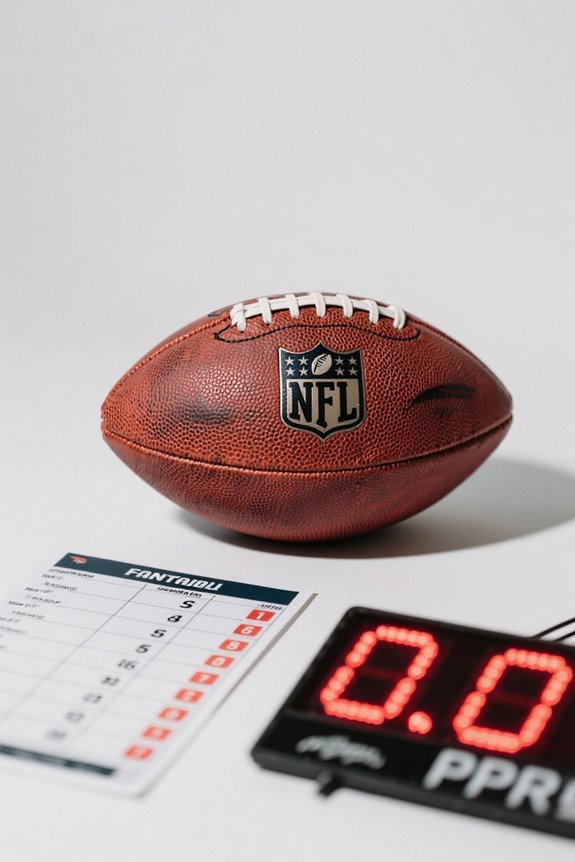
Scoring mechanics in standard fantasy football leagues adhere to a straightforward framework that emphasizes yardage and touchdowns as the primary means of point accumulation. Players earn yardage points, obtaining 1 point for every 10 rushing or receiving yards. Touchdown values further amplify point totals, with both rushing and receiving touchdowns worth 6 points each, while passing touchdowns typically score 4 points. Consequently, quarterbacks accrue points through 1 point per 25 passing yards. Defensive performance also contributes, as points are awarded for plays like sacks and interceptions. Unlike PPR leagues, standard formats do not reward receptions, impacting player valuations. Some leagues may implement bonuses, enhancing the scoring system’s complexity, yet the core mechanics remain firmly focused on yardage and touchdowns. Understanding integrated designs for maximum safety can help players choose gear that enhances performance in high-impact situations.
Impact on Player Values in PPR

Evaluating player values in PPR (Points Per Reception) leagues reveals considerable differences compared to standard scoring formats, particularly for skill-position players. The emphasis on pass-catching importance greatly influences fantasy value shifts, particularly for running backs, wide receivers, and tight ends. For instance, running backs like Alvin Kamara, with high reception totals, considerably increase their rankings, while those with fewer receptions, such as Derrick Henry, often drop in value. Additionally, wide receivers and tight ends benefit from consistent target volume, making them more valuable than their standard counterparts. Managers are therefore encouraged to prioritize versatile players who excel in receiving, ultimately altering draft strategies and player rankings to reflect the heightened emphasis on reception-based scoring in PPR formats.
Impact on Player Values in Standard Scoring
In standard scoring formats, player values are noticeably influenced by the absence of points awarded for receptions, leading to a distinct evaluation framework compared to PPR leagues. Consequently, player valuation emphasizes yardage and touchdowns—as points are granted primarily for these aspects. Running backs gain greater value through rushing yards and touchdowns, rather than reception volume, drastically altering scoring strategy. Similarly, wide receivers who achieve high yardage totals are prioritized over those with many receptions but fewer yards. This differential reward structure engenders an increased focus on big plays and touchdowns, which can lead to greater week-to-week scoring volatility. Overall, players who excel in scoring and yardage potential tend to have elevated value compared to those reliant on reception volume in standard scoring leagues. To maximize performance, understanding proper fit importance can help fantasy managers select players who can perform consistently well on the field.
Draft Strategies for PPR Leagues
Draft strategies for PPR (Point Per Reception) leagues frequently emphasize the significance of reception volume in player evaluations. In these formats, wide receivers gain increased draft impact due to their ability to generate points through receptions, often outperforming running backs in early rounds. Additionally, running backs who excel in the passing game, known as receiving backs, are prioritized over traditional workhorse backs. Early round selections tend to focus on high-ceiling wide receivers, while pass-catching running backs are strategically targeted in later rounds to enhance player consistency. Strong ankle support is also crucial for running backs making agile movements in the open field. Draft flexibility remains vital, as positional scarcity can shift, allowing savvy drafters to exploit value by adjusting their picks based on the reception potential of available players.
Recommended Products

#1 Sports Ankle Brace Trusted by Pros: Worn by NFL, NBA, MLS, and NCAA athletes, The BetterGuard 3.0 is the ultimate ankle brace for injury prevention and performance. Trusted by men, women, and teens for basketball, soccer, football, volleyball, and more. Built for athletes at every level.

#1 FOOTBALL ANKLE BRACE FOR STABILITY: Experience 2.4x more lateral support than inside-the-shoe braces without limiting the ability to run/push off

#1 Best All-Sports Ankle Brace, Trusted by Pros: Worn by top NFL, NBA, MLS, and NCAA athletes—The BetterGuard 2.0 delivers advanced ankle protection without compromising performance. It offers dynamic support and mobility for any sport or training regimen.
Draft Strategies for Standard Leagues
While traversing the complexities of standard fantasy football leagues, participants must understand the distinct positional value and roster construction that define ideal drafting strategies. In standard leagues, the requirement to start one quarterback, two running backs, two wide receivers, one tight end, and one flex player imposes unique constraints. Because of positional scarcity, drafting strategies should prioritize running backs in early rounds due to their higher scoring potential from rushing touchdowns. Subsequently, wide receivers may be targeted, as their depth allows flexibility. Quarterbacks, generally available in later rounds, can be paired strategically with wide receivers from the same team, maximizing scoring synergy. Consequently, a balanced approach permits adaptability while addressing the inherent value disparities among positions in standard leagues. Incorporating tools like sticky football gloves could enhance your catching technique and ball-handling skills, providing an additional advantage during your draft preparations.
Recommended Products

INCOMPARABLE GRIP: These sticky football gloves have C-TAK grip to enhance every play, rain or shine! Fumble-proof plays!

EXTREME GRIP TECHNOLOGY - Cutters patented C-TACK tech, provides the best grip for the ultimate performance, recharge mid-game using REV-TACK Recharge for boosted grip

Lightweight Design: Experience the freedom to fly with our lightweight soccer goalie gloves for kids 8-12. These soccer gloves for kids 8-12 help making every save feel like second nature. Perfect for youth goalkeeper gloves and goalie gloves for kids using professional level gloves even for youth soccer goalie gloves keepers.
Scoring Variants: Half-PPR and Beyond
Scoring variants in fantasy football, particularly the half-point per reception (Half-PPR) format, reveal significant shifts in player valuation and overall scoring dynamics when compared to traditional scoring systems. Half-PPR benefits players who excel in accumulating receptions, offering 0.5 points per reception while retaining 1 point for every 10 rushing or receiving yards and 6 points per touchdown. This scoring method provides a balanced reception strategy, reducing the skew often observed in full PPR. Consequently, it nudges some value towards pass-catching running backs, wide receivers, and tight ends, while maintaining a more equitable distribution of player value across positions. Overall, Half-PPR serves as a compromise, fostering a dynamic roster of fantasy-relevant players and creating parallels with agility training techniques that emphasize positive reinforcement strategies for effective player engagement.
Effects on Fantasy Football Gameplay
The difference in scoring formats, such as PPR and standard, fundamentally alters gameplay dynamics and player interactions within fantasy football leagues. PPR leagues enhance gameplay strategies by rewarding consistent reception volume, consequently increasing the value of pass-catching running backs and wide receivers. Consequently, managers prioritize players with high target shares, leading to significant scoring adjustments that affect lineup decisions each week. In contrast, standard leagues emphasize explosive plays, adjusting the focus toward touchdown production and rushing yardage. This distinction leads to variations in drafting philosophy, with managers in standard leagues favoring big-play specialists over consistent performers, ultimately impacting trading values and overall season management strategies. Hence, understanding the intricacies of each format is crucial for maximizing success in fantasy football. Moreover, recognizing the value of visibility in scrimmage vests can similarly impact strategic decisions in team-based sports contexts.
Popularity Trends in Fantasy Football Scoring
As fantasy football continues to evolve, the popularity of different scoring systems has become a significant point of discussion among players and leagues alike. Importantly, Point Per Reception (PPR) scoring emerged in the mid-2000s, aligning with the NFL’s shift toward pass-heavy offenses and enhancing player engagement through rewarding reception volume. Over the last decade, PPR formats have surged in popularity, prompting dynamic gameplay and engagement among participants. In contrast, standard scoring, which prioritizes yardage and touchdowns, remains favored by traditionalists. Moreover, half-PPR leagues have gained traction, appealing to players seeking a balance between the two. These trends in scoring evolution highlight a clear shift in player valuation and engagement driven by changing league dynamics and evolving NFL strategies.
Positional Value Changes in Different Formats
Understanding the differences in positional value across various fantasy football formats, particularly between Point Per Reception (PPR) and standard scoring, provides essential insights for players and managers alike. In PPR formats, the wide receiver impact is pronounced, as players receive points for each reception, considerably boosting their overall value, especially for those with high target shares. Conversely, standard scoring emphasizes running back efficiency, rewarding players like Derrick Henry, who accumulate yards and touchdowns with minimal pass-catching involvement. This scoring system expands the value of running backs, while diminishing that of wide receivers, who must rely on fewer big plays. Ultimately, the choice of scoring format fundamentally alters draft strategies and positional valuations within the fantasy landscape.
Recommended Products

CROWN YOUR CHAMPION IN STYLE - Celebrate fantasy football dominance with the TrophySmack 36" Tall, 19-Year Perpetual Championship Trophy – Silver Football—a bold, customized symbol of victory that turns heads and demands respect

EXCLUSIVE TROPHYSMACK DESIGN: Exclusively designed and manufactured by TrophySmack, Our Perpetual Fantasy Football Trophy is not for the faint of heart.

ONE Memorabilia or Autograph card per box!
Analyzing Player Performance in PPR Vs Standard
Analyzing player performance in fantasy football requires an acknowledgment of how different scoring systems, namely PPR and standard formats, markedly impact player valuation and scoring potential. PPR advantages lie in awarding points for receptions, greatly elevating the value of pass-catching running backs and wide receivers; conversely, standard drawbacks often diminish the importance of these players. Player adaptability becomes essential as managers adjust their strategies based on scoring nuances and league preferences. This evolution reflects drafting pass-catching backs and high-reception targets in PPR, while standard leagues prioritize yardage and touchdowns. Performance variability varies as PPR rewards consistency, whereas standard scoring often leads to boom-or-bust outcomes. Value assessments shift accordingly, influencing successful long-term fantasy strategies.
Customization and Flexibility in Fantasy Scoring Systems
Customization in fantasy scoring systems offers league managers significant flexibility to shape the game according to their preferences, thereby creating unique playing experiences. Managerial authority permits alterations to scoring categories and point assignments, including both standard stats like touchdowns and nuanced metrics such as fractional scoring for yardage. This fantasy flexibility enables leagues to adopt formats like PPR, incorporate negative scoring for mistakes, or establish hybrid scoring systems that reward various player skills. With the capability to adjust scoring settings at any point—retroactively recalibrating previous results—league rules can reflect a variety of strategic approaches. Ultimately, custom scoring profoundly impacts player valuation and strategies, allowing for tailored game dynamics that better mimic real-world football complexities.
Frequently Asked Questions
Can I Switch My League From Standard to PPR Mid-Season?
Switching a league from standard to PPR mid-season poses significant fairness issues. League commissioners often discourage such changes, as they disrupt strategies and player values established during the draft, risking competitive balance and enjoyment.
Are Tight Ends More Valuable in PPR Compared to Standard Scoring?
Tight end value increases notably in PPR formats, as scoring strategies favor receptions. High-volume pass catchers become essential, elevating their draft stock and weekly reliability compared to standard scoring, where yardage and touchdowns dominate.
How Do Injuries Affect Player Rankings in PPR Versus Standard Leagues?
Injury impacts greatly alter player rankings, with greater drops observed in PPR leagues for pass-catching positions. Standard leagues prioritize rushing efficiency, making player value more resilient to injuries that primarily affect reception opportunities.
Do Different Platforms Have Unique Rules for PPR Scoring?
Though consistency seems commonplace, various platforms showcase significant scoring variations. Platform differences shape PPR rules, impacting reception values and draft strategies, compelling managers to adapt their approaches based on specific scoring systems and formats offered.
Can I Create Custom Scoring Rules Beyond PPR and Standard?
Yes, custom scoring rules can be created beyond PPR and standard options to align with league preferences. Commissioners enjoy flexibility in defining point values and categories, enhancing the strategic depth of fantasy football leagues markedly.


